
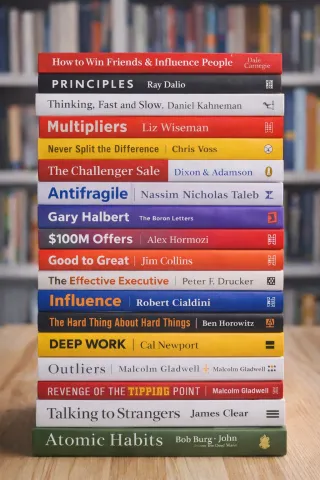
The books on this list are not here because they were popular or because someone told me to read them. They are here because they changed something. Each one either clarified an instinct I already had, exposed a habit that was costing me, or fundamentally shifted how I think about a problem I deal with every day.
I come back to this list every five years. Not to reread every book, but to check whether the frameworks still hold. They do. That is how I know they belong here.
The List
How to Win Friends and Influence People — Dale Carnegie
I read this early in my career and dismissed it as common sense. Then I realized I was not doing any of it. The core lesson — that success is shaped by how you make people feel, not by your credentials or your output — transformed how I sold, how I led, and how I handled conflict. Slowing conversations and leading with curiosity is not a soft skill. It is the most leveraged skill in business.
Principles — Ray Dalio
Dalio's central argument is that clarity requires deliberate construction. You cannot make consistent decisions by feel alone. Shifting from instinct-based reactions to principle-driven evaluation reduced my emotional responses and made me significantly more consistent across planning, hiring, and prioritization. The exercise of writing your own principles is worth the entire book.
Thinking, Fast and Slow — Daniel Kahneman
The most practically useful insight: confidence does not track accuracy. Recognizing when I was operating on System 1 — fast, intuitive, and often wrong — improved my hiring, forecasting, and strategic thinking. I learned to welcome dissent because I understood that obvious conclusions are often wrong in non-obvious ways.
Multipliers — Liz Wiseman
This book exposed a blind spot I did not know I had. My instinct when I saw a problem was to solve it immediately. Wiseman showed me that doing so consistently diminishes the team around you. The shift toward developing others' capabilities rather than demonstrating my own changed how my teams operated and how accountable they became.
Never Split the Difference — Chris Voss
Negotiation reframed entirely. The insight that changed everything for me is that negotiation is about emotional intelligence, not tactical positioning. Slowing conversations, naming emotions, and understanding what the other party actually needs underneath their stated position produced dramatically better outcomes — in contracts, in hiring, in every difficult conversation.
The Challenger Sale — Matthew Dixon and Brent Adamson
This book gave structure to an instinct I had always operated from: push clients toward new thinking rather than comfort them with agreement. The data showed that the most effective salespeople teach, tailor, and take control — not because they are aggressive, but because they understand the client's problem better than the client does. It informed everything we built at IGTMS.
Antifragile — Nassim Nicholas Taleb
Stop trying to eliminate volatility. Design systems that get stronger because of it. This shifted my entire orientation away from stability-seeking and toward adaptability-building. It reduced reactivity and dramatically improved how I make decisions under pressure.
Man's Search for Meaning — Viktor Frankl
Reframing suffering as a choice — specifically, the choice of how to respond — provided steadiness during the hardest periods I have navigated in business and in life. Meaning turned out to be more durable than momentum. I return to this book whenever I need to recalibrate what I am building and why.
The Boron Letters — Gary Halbert
Written from prison to his son, this book is raw, unconventional, and honest in a way that polished business writing almost never is. It covers attention, clarity, incentives, and the unchanging nature of human behavior with a directness that cuts through most of what passes for marketing advice. Required reading for anyone writing copy or building offers.
$100M Offers — Alex Hormozi
This shifted my diagnostic lens from effort and traffic to value and friction. If something is not selling, the problem is almost never effort. It is offer clarity or risk removal. This book simplified how I evaluate and structure every commercial engagement.
Good to Great — Jim Collins
Discipline over intensity. Right people before direction. Sustainable growth over heroic effort. These principles reinforced what I have seen in every business I have built or helped build. The Hedgehog Concept alone is worth the read — understanding what you can be the best at, what drives your economics, and what you are deeply passionate about is the framework every founder should pressure-test annually.
The Effective Executive — Peter Drucker
Drucker transformed how I think about time. The distinction between activity and contribution changed what I track and what I ignore. Focus shifted toward decisions and work with actual outcome impact. This is the book I recommend most often to founders who feel busy but not effective.
Influence — Robert Cialdini
Once you understand the six principles of influence — reciprocity, commitment, social proof, authority, liking, scarcity — you see them everywhere. In pricing, in negotiation, in culture, in marketing. Understanding them made me better at building systems that work with human psychology rather than against it.
The Hard Thing About Hard Things — Ben Horowitz
This is the most honest book about leadership I have read. No promises, no platitudes — just what it actually feels like to carry difficult decisions when no option is clean. I come back to this one whenever I need a reminder that hard is not wrong.
Deep Work — Cal Newport
Attention is the scarcest resource in business, and most environments are designed to destroy it. This book reinforced the importance of protecting focus through structure and refusing to reward constant availability. The work that actually moves things forward requires sustained concentration. Everything else is maintenance.
Outliers — Malcolm Gladwell
Context, timing, and repetition matter more than raw talent. This softened my performance judgments and improved my leadership by teaching me to design environments rather than depend on individual excellence. The implication for hiring and team building is significant.
Atomic Habits — James Clear
Systems outperform motivation. Always. This book is not inspiring in the traditional sense — it is structural. It showed me how to design the conditions for desired behaviors to be the default. The lesson that culture reveals itself through repeated actions rather than stated intentions is one I apply constantly.
The Go-Giver — Bob Burg and John David Mann
Value creation, trust, and generosity as strategy rather than sentiment. This is the book I leave in the investment properties I own. It is a reminder that the long game in business and in relationships is built by consistently giving more than you take. It sounds soft. It is one of the most durable competitive advantages I know.
Every book on this list has paid back its reading time many times over. Not through inspiration, but through changed behavior. That is the only test that matters.